Mudjacking vs. Foam injection: ten factors that affect pricing.
Both methods can lift sunken concrete, but only one is what Epp Foundation Repair installs. Here are the ten factors behind the price difference and why.
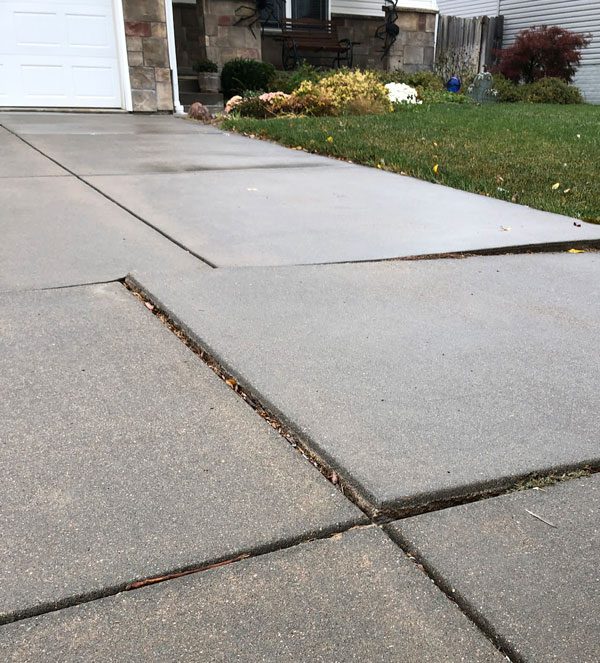
Both mudjacking and polyurethane foam injection can lift sunken sidewalks, driveways, and garage floors, but they do it differently, cost differently, and perform differently over time. Here are the ten factors that most directly affect what each method costs, and why Epp Foundation Repair's crews only install polyurethane foam.
Epp Foundation Repair does not perform mudjacking. Our crews use polyurethane foam injection on every concrete lifting job, for the reasons laid out below. This comparison is here so homeowners researching either method understand what they're actually paying for and why.
1. Material cost per cubic foot
Mudjacking slurry. A mix of topsoil, sand, Portland cement, and water. Costs significantly less per unit than two-part polyurethane foam. This is the primary reason mudjacking quotes often come in lower on large jobs. Foam's material advantage is weight: it's roughly 50 times lighter than slurry, which matters when the underlying soil is already compromised.
2. Volume and depth of voids beneath the slab
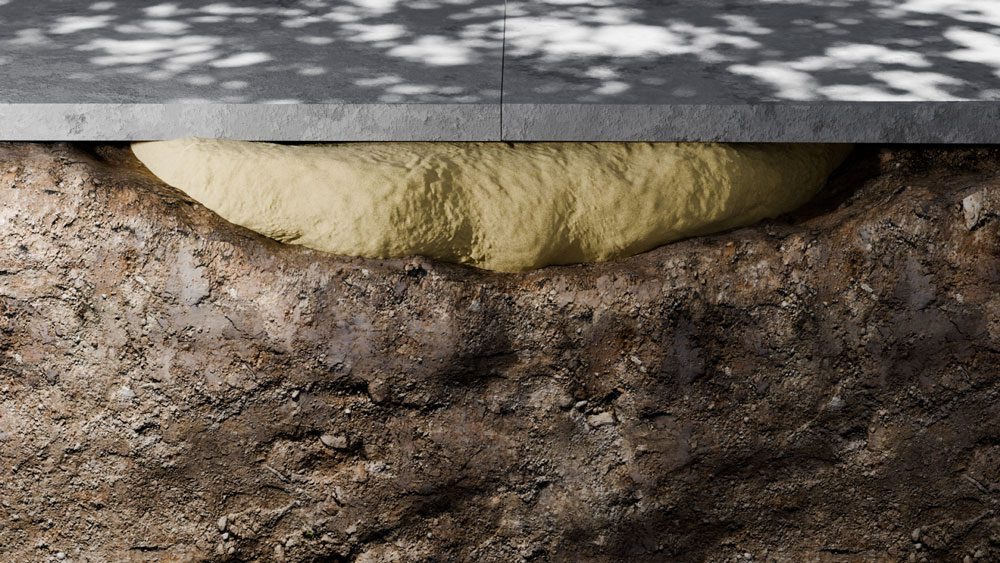
Large or deep voids beneath a slab require more material to fill regardless of method. Deep voiding under a garage floor or driveway substantially increases material cost for both approaches. If voids are extensive, the estimate will reflect it. On either side.
3. Slab size and number of injection ports
Pricing scales with the number of drill holes required, which scales with slab area and settlement distribution. Foam typically requires fewer and smaller ports than mudjacking, reducing drilling cost on large areas. On a long driveway, this difference can be meaningful.
4. Slab thickness and condition
Thinner slabs (3 to 4 inches) are more prone to cracking during the lift. Both methods carry risk here, but foam's controlled low-pressure expansion gives more lift precision on delicate slabs. Slabs with existing cracks that run full-depth need a different approach entirely. Lifting them can worsen the damage.
5. Accessibility
Mudjacking equipment is bulkier. Tight access. A narrow side yard, a garage with a low door, an interior space with limited clearance. Can make mudjacking impractical or impossible. Foam equipment is more compact and can reach spaces mudjacking equipment can't enter.
6. Required cure time
Mudjacking typically requires 24 to 48 hours before the surface can take traffic. Homeowners can walk on a slab lifted with polyurethane foam 15 minutes after installation is complete. For any area that needs to be back in use quickly, foam's fast cure is worth the price premium on its own.
7. Soil and moisture conditions
Foam performs better in wet or saturated conditions. It doesn't dilute or wash away. Mudjacking slurry can migrate in high-moisture environments before it cures. If water is part of the problem causing the settlement, foam is the more reliable choice.
8. Long-term durability
Polyurethane foam is waterproof, inert, and doesn't add significant weight to the soil beneath the slab. Mudjacking adds material weight that can contribute to further settlement in marginal soil conditions. For long-term performance on compromised ground, foam holds its edge. Particularly in climates with heavy seasonal moisture variation, like Nebraska, Iowa, Kansas, and Missouri.
9. Project scale
Mudjacking's per-unit cost advantage is most pronounced on very large, straightforward jobs: long driveways, commercial parking areas, warehouse floors, where material volume is high and access is easy. Epp Foundation Repair's crews use polyurethane foam on projects of every size, because the precision, faster cure, and lighter load matter on nearly every residential job regardless of scale.
10. Regional contractor market
In the regional contractor market, foam injection typically runs 25 to 50% higher than mudjacking for equivalent jobs. The premium buys faster cure, lighter fill, and better moisture resistance. Whether that premium is justified for your specific slab depends on your soil conditions, timeline, and how the slab is used. Epp Foundation Repair only installs polyurethane foam, and every estimate starts with an on-site inspection of the slab and the soil underneath it.

Written by
Owner and President, Epp Foundation Repair
Dave joined the family business in 2004 after growing up watching his father Phil build it from the ground up. Today he runs daily operations across Epp's service region in Nebraska, Iowa, Kansas, and Missouri, and is trained and experienced across every repair method Epp installs.
More about Dave